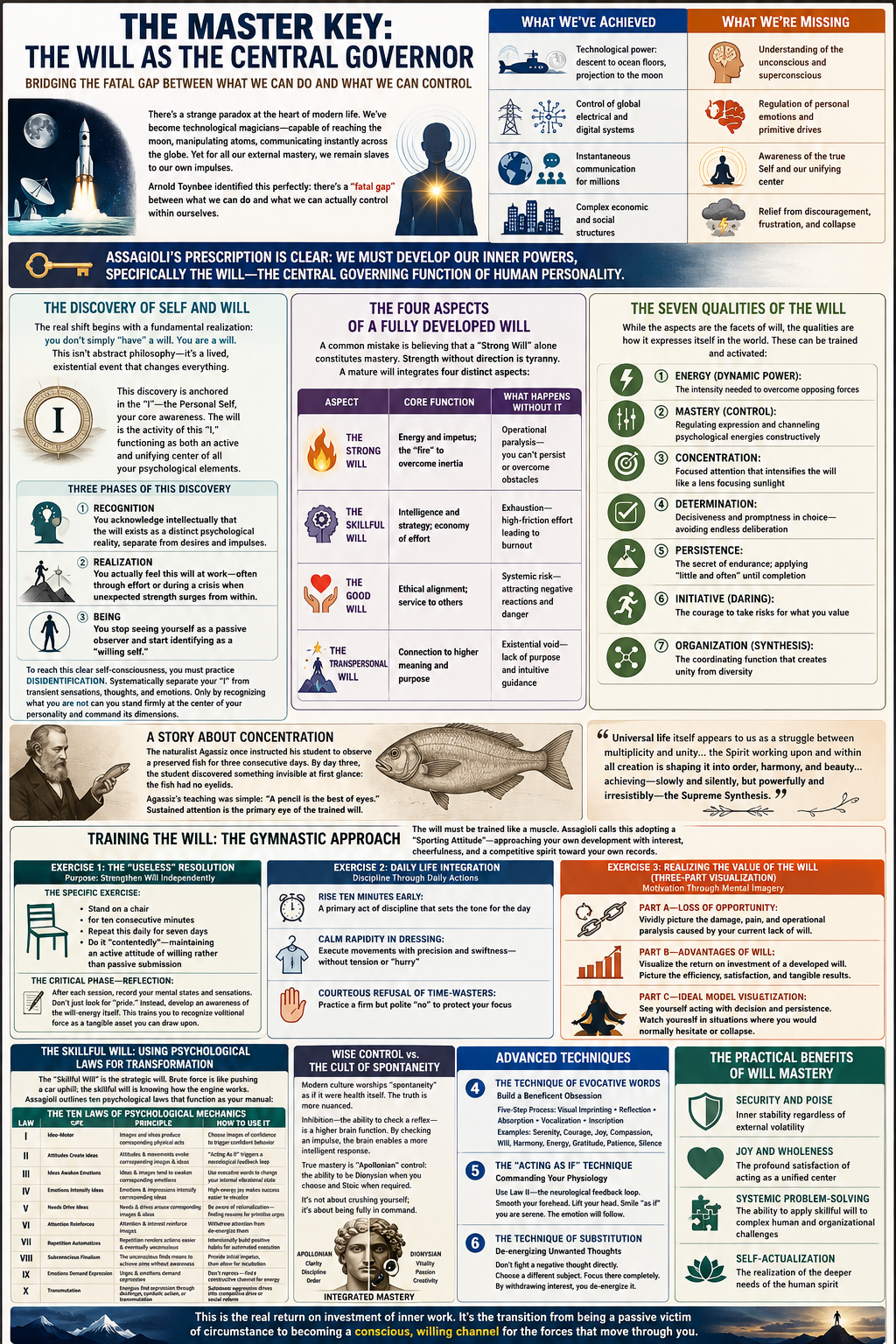
There’s a strange paradox at the heart of modern life. We’ve become technological magicians—capable of reaching the moon, manipulating atoms, communicating instantly across the globe. Yet for all our external mastery, we remain slaves to our own impulses. Arnold Toynbee identified this perfectly: there’s a “fatal gap” between what we can do and what we can actually control within ourselves.
We’re competent with the external world but novices when it comes to governing our own emotions, desires, and drives. The pace of modern life demands a psychological equilibrium most of us simply don’t possess. We’ve mastered the forces of nature but remain largely unconscious of our own depths.
| What We’ve Achieved | What We’re Missing |
|---|---|
| Technological power: descent to ocean floors, projection to the moon | Understanding of the unconscious and superconscious |
| Control of global electrical and digital systems | Regulation of personal emotions and primitive drives |
| Instantaneous communication for millions | Awareness of the true Self and our unifying center |
| Complex economic and social structures | Relief from discouragement, frustration, and collapse |
Assagioli’s prescription is clear: we must develop our inner powers, specifically the Will—the central governing function of human personality.
The Discovery of Self and Will
The real shift begins with a fundamental realization: you don’t simply “have” a will. You are a will. This isn’t abstract philosophy—it’s a lived, existential event that changes everything about how you relate to life.
Three Phases of This Discovery
- Recognition: You acknowledge intellectually that the will exists as a distinct psychological reality, separate from desires and impulses.
- Realization: You actually feel this will at work—often through effort or during a crisis when unexpected strength surges from within.
- Being: You stop seeing yourself as a passive observer and start identifying as a “willing self.”
This discovery is anchored in the “I”—the Personal Self, your core awareness. The will is the activity of this “I,” functioning as both an active and unifying center of all your psychological elements.
To reach this clear self-consciousness, you must practice Disidentification. Systematically separate your “I” from transient sensations, thoughts, and emotions. Only by recognizing what you are not can you stand firmly at the center of your personality and command its dimensions.
The Four Aspects of a Fully Developed Will
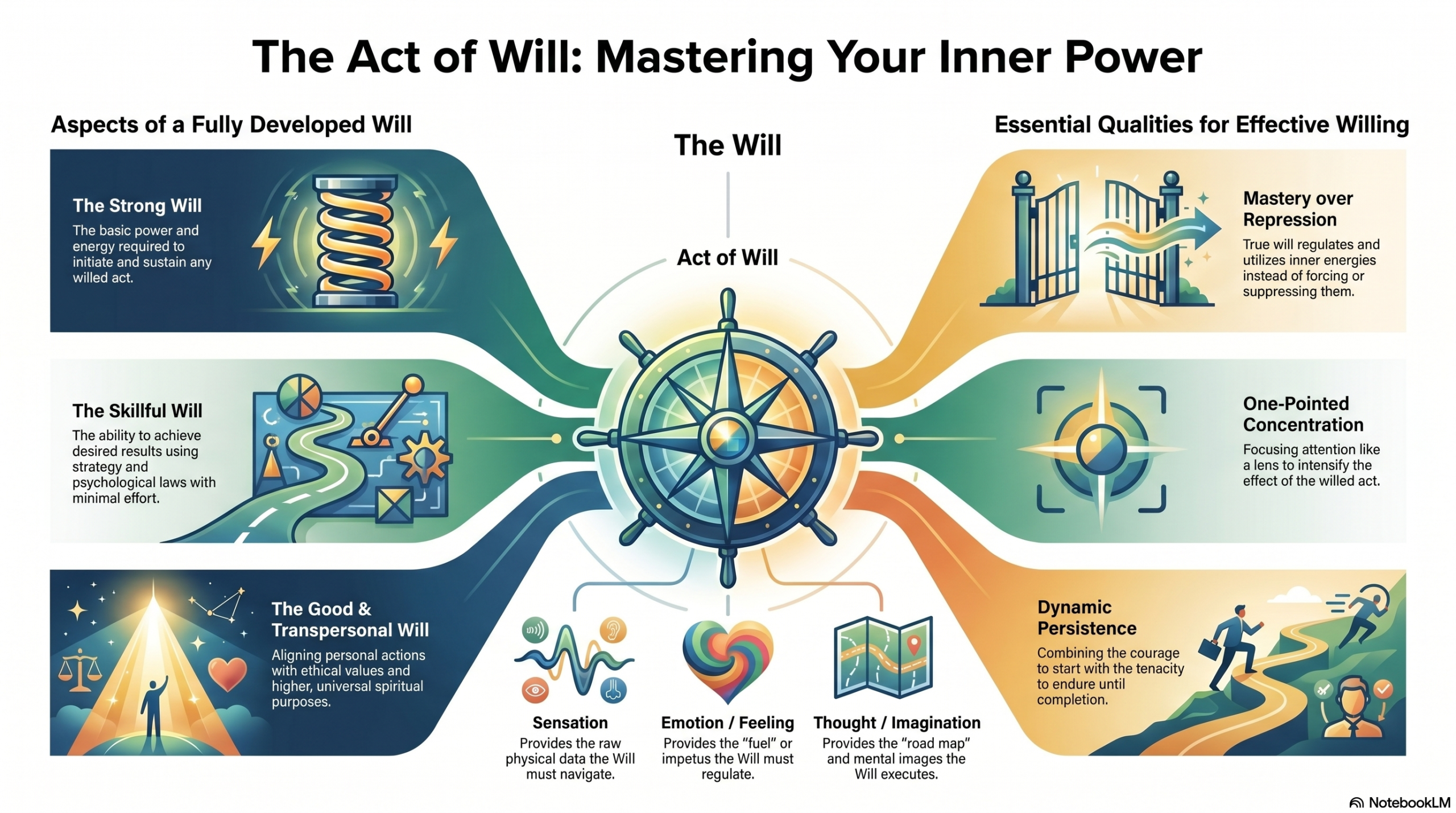
A common mistake is believing that a “Strong Will” alone constitutes mastery. Strength without direction is tyranny. A mature will integrates four distinct aspects:
| Aspect | Core Function | What Happens Without It |
|---|---|---|
| The Strong Will | Energy and impetus; the “fire” to overcome inertia | Operational paralysis—you can’t persist or overcome obstacles |
| The Skillful Will | Intelligence and strategy; economy of effort | Exhaustion—high-friction effort leading to burnout |
| The Good Will | Ethical alignment; service to others | Systemic risk—attracting negative reactions and danger |
| The Transpersonal Will | Connection to higher meaning and purpose | Existential void—lack of purpose and intuitive guidance |
The Seven Qualities of the Will
While the aspects are the facets of will, the qualities are how it expresses itself in the world. These can be trained and activated:
- Energy (Dynamic Power): The intensity needed to overcome opposing forces
- Mastery (Control): Regulating expression and channeling psychological energies constructively
- Concentration: Focused attention that intensifies the will like a lens focusing sunlight
- Determination: Decisiveness and promptness in choice—avoiding endless deliberation
- Persistence: The secret of endurance; applying “little and often” until completion
- Initiative (Daring): The courage to take risks for what you value
- Organization (Synthesis): The coordinating function that creates unity from diversity
A Story About Concentration
The naturalist Agassiz once instructed his student to observe a preserved fish for three consecutive days. By day three, the student discovered something invisible at first glance: the fish had no eyelids. Agassiz’s teaching was simple: “A pencil is the best of eyes.” Sustained attention is the primary eye of the trained will.
Training the Will: The Gymnastic Approach
The will must be trained like a muscle. Assagioli calls this adopting a “Sporting Attitude”—approaching your own development with interest, cheerfulness, and a competitive spirit toward your own records.
Exercise 1: The “Useless” Resolution
Perform a deliberate act with no practical purpose other than training your will.
The Specific Exercise:
- Stand on a chair for ten consecutive minutes
- Repeat this daily for seven days
- Do it “contentedly”—maintaining an active attitude of willing rather than passive submission
The Critical Phase—Reflection:
After each session, record your mental states and sensations. Don’t just look for “pride.” Instead, develop an awareness of the will-energy itself. This trains you to recognize volitional force as a tangible asset you can draw upon.
Exercise 2: Daily Life Integration
- Rise Ten Minutes Early: A primary act of discipline that sets the tone for the day
- Calm Rapidity in Dressing: Execute movements with precision and swiftness—without tension or “hurry”
- Courteous Refusal of Time-Wasters: Practice a firm but polite “no” to protect your focus
Exercise 3: Realizing the Value of the Will (Three-Part Visualization)
Part A—Loss of Opportunity:
Vividly picture the damage, pain, and operational paralysis caused by your current lack of will. See the opportunities missed, the relationships strained, the potential unrealized. Don’t be gentle with yourself here.
Part B—Advantages of Will:
Visualize the return on investment of a developed will. Picture the efficiency, satisfaction, and tangible results. See yourself moving through life with ease and decisiveness.
Part C—Ideal Model Visualization:
See yourself acting with decision and persistence. Watch yourself in situations where you would normally hesitate or collapse. This is “Visual Imprinting” of your future self.
The Skillful Will: Using Psychological Laws for Transformation
The “Skillful Will” is the strategic will. Brute force is like pushing a car uphill; the skillful will is knowing how the engine works. Assagioli outlines ten psychological laws that function as your manual:
The Ten Laws of Psychological Mechanics
| Law | Principle | How to Use It |
|---|---|---|
| I: Ideo-Motor | Images and ideas produce corresponding physical acts | Choose images of confidence to trigger confident behavior |
| II: Attitudes Create Ideas | Attitudes and movements evoke corresponding images and ideas | “Acting As If” triggers a neurological feedback loop |
| III: Ideas Awaken Emotions | Ideas and images tend to awaken corresponding emotions | Use evocative words to change your internal vibrational state |
| IV: Emotions Intensify Ideas | Emotions and impressions intensify corresponding ideas | High-energy joy makes success easier to visualize |
| V: Needs Drive Ideas | Needs and drives arouse corresponding images and ideas | Be aware of rationalization—finding reasons for primitive urges |
| VI: Attention Reinforces | Attention and interest reinforce images | Withdraw attention from negative outcomes to de-energize them |
| VII: Repetition Automatizes | Repetition renders actions easier and eventually unconscious | Intentionally build positive habits for automated execution |
| VIII: Subconscious Finalism | The unconscious finds means to achieve aims without awareness | Provide initial impetus, then allow for incubation |
| IX: Emotions Demand Expression | Urges and emotions demand expression | Don’t repress—find a constructive channel for the energy |
| X: Transmutation | Energies find expression through discharge, symbolic action, or transmutation | Sublimate aggressive drives into competitive drive or social reform |
Wise Control vs. The Cult of Spontaneity
Modern culture worships “spontaneity” as if it were health itself. The truth is more nuanced. Inhibition—the ability to check a reflex—is a higher brain function. By checking an impulse, the brain enables a more intelligent response.
True mastery is “Apollonian” control: the ability to be Dionysian when you choose and Stoic when required. It’s not about crushing yourself; it’s about being fully in command.
Advanced Techniques: Evocative Words and “Acting As If”
Exercise 4: The Technique of Evocative Words
By placing a word representing a “Being-Value” in a visible place, you create what Assagioli calls a “beneficent obsession.” Choose from qualities like:
Serenity, Courage, Joy, Compassion, Will, Harmony, Energy, Gratitude, Patience, Silence
The Five-Step Process:
- Visual Imprinting: View the word for 2 minutes with full attention
- Reflection: Meditate on the word’s deeper meaning and implications
- Absorption: Let the quality permeate your psyche; don’t force it
- Vocalization: Say the word aloud or murmur it repeatedly
- Inscription: Write the word repeatedly to fix it in your psyche
The effect is cumulative. Over days and weeks, the word begins to alter your internal landscape.
Exercise 5: The “Acting As If” Technique
This uses Law II—the neurological feedback loop. You may not be able to “will” an emotion directly, but you can command your physical posture.
The Principle:
Smooth your forehead. Lift your head. Smile “as if” you are serene. The emotion will eventually match the physical command.
Historical Examples:
General Turenne’s Mastery: Turenne’s body trembled with fear before battle. He told his “carcass”: “Tremble, old body, but walk!” He mastered his physiology through the will’s command, and the emotion followed.
Goethe’s Vertigo: Goethe suffered from severe vertigo. Rather than avoid heights, he repeatedly climbed the Minster spire, forcing himself to look down. Through repeated exposure, the sensation became indifferent to him. This is strategic desensitization through will.
Exercise 6: The Technique of Substitution
Don’t fight a negative thought directly. Instead:
- Simply choose a different subject
- Focus your attention there completely
- By withdrawing interest, you de-energize the unwanted image
Resistance gives energy to what you resist. Substitution starves it of attention.
The Practical Benefits of Will Mastery
What does this work actually give you? The systematic development of the will leads to a fundamental transformation: from a fragmented collection of impulses to a unified, effective organism.
- Security and Poise: Inner stability regardless of external volatility
- Joy and Wholeness: The profound satisfaction of acting as a unified center
- Systemic Problem-Solving: The ability to apply skillful will to complex human and organizational challenges
- Self-Actualization: The realization of the deeper needs of the human spirit
This is the real return on investment of inner work. It’s the transition from being a passive victim of circumstance to becoming a conscious, willing channel for the forces that move through you.
“Universal life itself appears to us as a struggle between multiplicity and unity… the Spirit working upon and within all creation is shaping it into order, harmony, and beauty… achieving—slowly and silently, but powerfully and irresistibly—the Supreme Synthesis.”