Theme: Stability, materiality, patience, sensuality, value
Element / Modality: Earth / Fixed
Ruler: Venus
Archetypes: Hathor (Egyptian), Aphrodite (Greek), Lakshmi (Hindu), Freyja (Norse), Geb (Egyptian)
Overview
Taurus is the energy of embodiment, presence, and sustained power. Where Aries starts, Taurus continues. It doesn’t explode—it endures. Taurus builds, holds, conserves, and grounds. It governs the material world: body, land, money, food, and possessions.
In magick, Taurus is the force that holds a ritual in place. It provides the vessel, the structure, the patience. It teaches you to stay put and do the work, to make your results real and tangible.
Key Traits to Work With
- Stability: Holding your ground in chaos or distraction.
- Endurance: Continuing long after the spark fades.
- Sensuality: Experiencing the world through touch, smell, taste, and rhythm.
- Value: Knowing your worth and what’s worth pursuing.
- Possession: What you have, what has you, and how you manage both.
When imbalanced, Taurus becomes rigid, lazy, possessive, or resistant to change. The lesson is to stay grounded but not stuck.
Psychological Focus
Taurus relates to the body-self—your sense of being a physical being in a physical world. It also rules your sense of security and personal values. In theurgical work, Taurus stabilises the psyche and integrates power into form. You can work with Taurus to:
- Strengthen your connection to the body and senses
- Establish financial or emotional security
- Develop consistent habits or spiritual practice
- Clarify what you truly value and what you’re clinging to out of fear
Journaling prompt: What in your life gives you real nourishment? What do you own—and what owns you?
Magickal Applications
- Money and prosperity spells
- Rituals for physical healing and embodiment
- Land-based and nature magick
- Creating sacred space or altars
- Long-term enchantments and protections
- Grounding chaotic or excessive energies
Best times to work: Friday (Venus’ day), sunset, during Taurus Moon or Sun in Taurus (April 20 – May 20)
Theurgical Contact and Invocation
Taurus deities are usually patient, sensual, and powerful in a quiet, sustaining way. They may not answer quickly, but their influence is lasting. Contact often comes through the body, the earth, or simple presence.
Archetypes to work with:
- Hathor – fertility, beauty, music, cattle, pleasure
- Aphrodite – physical love, attraction, aesthetics, values
- Lakshmi – wealth, prosperity, fortune, sacred order
- Freyja – abundance, love, gold, sovereignty
- Geb – the personified Earth, rest, endurance, silence
Methods of contact:
- Sit or lie directly on the earth
- Use green, copper, rose, or sandalwood
- Offer food, flowers, or coins
- Chant slowly with a deep, resonant voice
- Practice stillness and listen to the body
- Gardening or touching soil, stones, or clay
Try this invocation aloud:
I call upon the power of Taurus.
Earth below, body within, value enduring.
Let me stand firm in the world.
Let what is good take root.
Let beauty, strength, and calm be mine.
Then rest. And trust.
Exercises
1. Sensory Anchor
Light a candle and slowly eat a small piece of fruit, chocolate, or bread. Do nothing else. Let this become a grounding ritual to reconnect with the body and present moment.
2. Value Audit
- Make a list of the ten things you spend most time or money on
- Make a list of your stated values
- Compare the two
This reveals where Taurus energy is distorted—when what you say you value and what you actually prioritise are out of alignment.
3. Earth Mantra
Stand barefoot on natural ground. Speak this mantra slowly, three times:
I am held.
I am here.
I am enough.
I am safe.
Let each phrase settle into the bones.
Shadow and Integration
Taurus can resist change even when change is needed. Comfort becomes control. Ownership becomes hoarding. Pleasure becomes passivity.
The high path of Taurus is mastery through consistency. Not quick flashes, but real embodiment. Not grand gestures, but steady presence. It’s not exciting—but it’s real. And realness is power.
Use Taurus to slow down, dig deep, and make your practice real—something you live, not something you chase.
Taurus Pathworking — The Gate of Presence
Find a comfortable position. Close your eyes. Take three slow breaths — and with each exhale, let your body grow heavier, more settled, more still. You do not need to be anywhere else. You do not need to do anything yet. Keep your eyes closed throughout this entire working. Allow the following images to form in your mind’s eye.
You stand at the centre of the temple.
The night air is still. Around you, the grey stone wall rises, slightly higher than your body, its twelve curtained segments each a doorway into a different current of energy. This circular wall is your boundary. It is the edge of your sphere, your mind, your aura, everything that you are.
You are facing east. Beyond the wall in that direction, a tall forest stands dark and breathing, its trees ancient and still. To your right in the south, beyond the wall, a volcano holds its slow fire — a deep orange glow at the horizon, patient and permanent. Behind you to the west, the mist from a distant river has drifted gently into the circle, mingling with the soft sound of a small fountain within the wall — you feel its cool moisture on your back. To your left in the north, a high cliff rises into darkness, and at its base the entrance to a cave breathes a cool, earthy scent into the circle — you feel it as a faint coolness on your left side.
The stone beneath your feet is solid. You feel it. You feel your own weight upon it — the simple fact of your body, standing, present, here.
You breathe in. The air carries something faintly rich — the beginning of something deeper, something from the earth itself.
You turn slowly to your right, moving clockwise from east. One segment. Two. You stop before the second curtain of the wall — the segment of Taurus.
The curtain before you is deep green — not the bright green of new growth, but the darker, denser green of things that have been growing for a long time. Heavy fabric, barely moving. It has a settled quality, as though it has hung here since before you were born and will hang here long after.
On either side of the curtain, three shrines are set into the brick, arranged vertically — each slightly recessed, each holding a figure. You begin at the top left and move your attention downward.
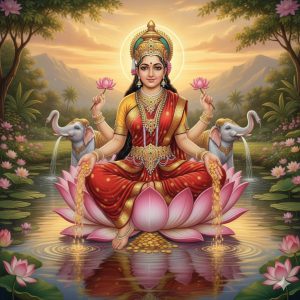
The highest on the left is Lakshmi — a radiant Indian woman seated on an open lotus, her skin warm gold, her robes deep red and gold. From her raised hands, coins fall in a continuous stream. Her expression is generous and entirely untroubled, the face of someone for whom abundance is simply the natural state of things.
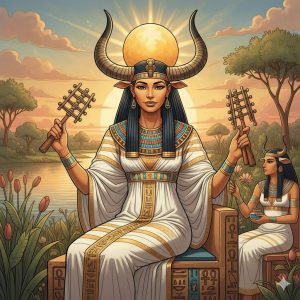
Below her is Hathor — an Egyptian woman with the curved horns of a cow framing a solar disc above her head, her bearing queenly and warm. She carries a sistrum — a handled rattle — and wears a collar of turquoise and gold. Her presence is lush, pleasurable, the sense that beauty and the body are sacred things.
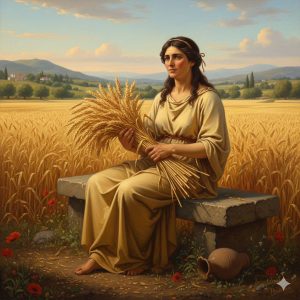
Below her is Demeter — a mature Greek woman in a simple robe the colour of wheat, her hair unadorned, her hands holding stalks of grain. There is something vast and patient in her face — the patience of the earth itself, which gives without hurrying and endures without complaint.
You pause before each of them. You feel what each one carries.
Then you turn to the right side of the curtain. Three more shrines, again top to bottom.
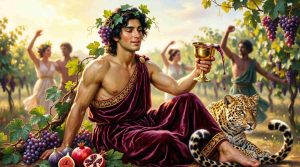
The highest is Dionysus — a Greek man younger than you might expect, wreathed in vine leaves, a bunch of dark grapes in one hand, a shallow cup in the other. His expression is neither wild nor sober but something in between — present, satisfied, the pleasure of the moment fully inhabited. Beneath the ease there is something older, something that knows the earth in its depths.
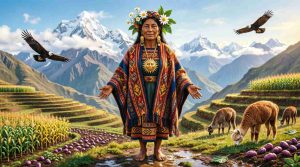
Below him is Pachamama — a figure rooted rather than standing, her form broad and dark, her clothing layered in deep ochres and reds and the brown of turned soil. She does not look outward. She looks down, or inward. Offerings have been pressed into the earth at her feet — seeds, small coins, dried flowers. Her presence is the heaviest of the six — the most ancient, the most physical, the most simply and completely here.
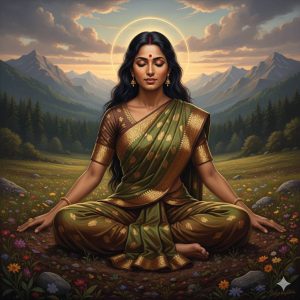
Below her is Prithvi — an Indian woman of immense stillness, dressed in deep greens and browns, her hands pressed lightly to the ground at her sides. She is the earth as a conscious being — the ground that sustains everything, that asks nothing, that holds all weight without shifting. Her expression is the most still of all the figures here. She has been here since before memory.
You stand between the six of them.
Six faces of the same force. Six ways of understanding what it means to be fully present in a body, in a life, in physical form — to hold what you have been given with care and without grasping. To tend the earth of your own existence.
You let your awareness open to your own life for a moment. The things you hold — the wealth you are building, the body you inhabit, the physical life you are making. The things you want to protect and to keep. The sense that what endures matters. That what is tended carefully grows.
You feel that force beginning to stir in you. Something low in the body. Something settled and strong.
One of these figures calls to you more than the others. You don’t need to decide with your mind. Simply notice which one your attention returns to. This is the deity you will carry with you today. Hold their face, their bearing, the quality of their energy in your awareness. You will know them again when you see them.
Now turn your attention to the curtain.
Above the curtain you see a large image — painted or woven, the colours saturated and close. Two figures rendered with great formality — one elevated, one receiving — the scene dense with ritual. Between them, the transfer of something ancient and exact. Keys at the base. Pillars on either side. The whole image has the quality of sacred knowledge being handed down through time, of tradition as a living thing, of what has always been true being given again.
On the curtain itself, the glyph of Taurus glows in bright yellow — a circle with two curved horns rising above it, the shape of the bull’s head, the shape of the full moon held between its horns. Below it, the symbol of Venus — its circle and cross. And the elemental symbol of earth — a green downward-pointing triangle with a horizontal line across its lower third, solid and grounded.
You take them in. You feel what they mean — not as concepts but as qualities in your body.
Now you look to your left.
Set into a bracket in the wall at just the right height is a smooth river stone — palm-sized, heavy for its size, dark grey with a faint lustre. Old. It has been in water for a very long time. You reach out and take it in your hand.
The weight of it settles immediately into your palm. Cool, dense, unhurried. You feel your hand close around it — the complete solidity of it, the way it simply is what it is, with no performance and no urgency. This stone is not a symbol of wealth exactly. It is a symbol of what wealth really is — the thing that endures. The thing that holds its form. The thing that stays.
You carry it with you as you part the curtain.
The fabric is heavier than you expected — thick, close-woven, warm to the touch. It yields slowly and with a kind of dignity.
You step through.
The corridor is old brick, lit by candles set low along the base of the walls. The flames here are steadier and slower than elsewhere — they barely flicker. The passage is narrow enough that you are aware of the walls on either side.
And the smell reaches you before anything else — dark earth after rain, with something richer beneath it, something warm and almost sweet. Resin, perhaps. Or the inside of old wood. It arrives in the chest like something remembered from deep in the body. You breathe it in and something in you slows — not dulls, but settles, dropping its weight into the ground beneath your feet.
On the walls of this corridor, images appear. You don’t need to analyse them. Simply let them register.
On your left: yourself in a state of complete physical solidity — your body healthy and strong, well-tended, vital. The body that consistent care and respect would produce. You feel for a moment what it would be like to inhabit that. The ease of it. The simple rightness of a body that has been looked after.
On your right: yourself with your wealth held safely — not spent, not scattered, growing quietly in the dark the way things grow in earth. Your holdings secure. Your legacy intact. The things you are building now outlasting you, passing on as you intend, preserved exactly as you determined.
Further along: yourself completely present in a single moment — not thinking about what comes next, not reviewing what came before. Simply here, in a body, in a life, receiving what is actually available right now. The pleasure of that. The fullness of it.
As you pass each image you feel what it would be like to be that version of yourself.
Notice how you are walking. Your steps are slow and deliberate, each foot placed fully and consciously before the next is lifted. Your weight moves down with each step as much as forward — as though you are pressing lightly into the earth, as though the ground and your body are in conversation. This is how a person who is fully present in their physical life moves. Not rushing toward the next thing. Simply here, completely, at each moment of the walk.
The scent of earth and resin deepens. The candle flames steady. Something in you is thickening — in the best sense, becoming more substantial, more real, more undeniably here.
You emerge from the corridor.
And the world arrives — not all at once, but in a slow opening, like eyes adjusting to a different quality of light.
Green. Everywhere green — the deep, dense, ancient green of a landscape that has been growing for a very long time. You are standing on earth — dark, soft, faintly warm underfoot, the kind of earth that gives slightly under your weight and holds the impression of your foot. Around you, trees — old, wide, their roots visible at the surface, their canopies high enough that the light comes through in long, slow columns. The air is cool and full — rich with moisture and earth and living things. Somewhere nearby, water moves — a stream, unhurried, finding its way through stone.
The light here is neither morning nor afternoon — it is the full, even light of the middle of a day that seems to have no particular urgency about ending.
And you feel it — in the body before the mind catches up.
A quality of weight. Not heaviness — something different. The sense of your own physical existence as something real and substantial, worthy of care, worthy of presence. The feeling that being here, in this body, in this life, is enough. More than enough. That there is no other place you are supposed to be.
This is presence. Not the presence you achieve through effort — the presence that arises when you simply stop leaving. When you let the body be where it is. When the physical world is allowed to be fully real.
You feel it in your feet, in your palms, in the hand that holds the stone — the stone whose weight has been with you since the threshold, reminding you with each step that what is solid is real, and what is real is worth holding.
The scent here is fullest now — earth and resin and something faintly floral, something in bloom somewhere among the trees. You breathe it in completely.
Then you begin to walk toward the centre of this place. Slowly. Each step deliberate. Each step a small act of presence.
You move toward an altar.
It is wide and low — not iron like Aries, but stone, ancient limestone, its surface worn smooth by time and use. On it: a bowl of dark earth, packed dense, with something green growing from it — small, new, persistent. A handful of grain, loose on the stone. A piece of amber, translucent, with something ancient suspended inside it. A small bronze mirror, its surface clouded with age. A cup of deep red wine. And at the altar’s centre, a cluster of fresh herbs — rosemary, thyme — their scent rising slowly into the still air.
And standing at the altar, or present in the rich, heavy air just beyond it — your deity. The one whose face called to you at the threshold shrines. You know them. You feel the recognition in your body before your mind confirms it. Their energy is the same quality that stirred in you in the corridor, but here it is concentrated — immediate, warm, entirely present with you.
You step closer.
You feel gratitude — genuine, unperformed. Gratitude that this force exists. Gratitude that the physical world is real, that beauty is real, that what you hold and tend and protect has genuine value. Gratitude that your body is yours, that your wealth is something you are building with intention, that the life you are making is not accidental.
Now you take the stone — this cool, dense, ancient stone that has been in your hand since the threshold — and you place it on the altar. You set it down among the other objects, in the space that was waiting for it.
This is your offering. Not of the object, but of what it represents — your willingness to be here, fully, in physical form. Your commitment to tend what you are given. Your intention to hold what matters with care, and to let it endure.
The deity receives it. You feel the moment of contact — a deepening of the warmth in the air, something that moves through your hand and settles low in your body, in the place where the body knows it is grounded.
And now something is given back.
Understand this: you are not simply visiting a realm. You are establishing a relationship. A living connection between yourself and this force — this deity, this energy — that does not end when the pathworking ends. You can call on this connection in your daily life. In the moments when you feel scattered, unmoored, pulled thin across too many things — bring this deity’s image clearly into your mind. Hold it there with faith and with concentration. Let the weight of them settle you. And the deity will answer. The energy will move. This is what the ancients understood, and it is the truth: that a sustained, faithful mental image of a divine force, held with genuine intention, opens a channel between your life and that force.
This altar, this figure, this place — remember it. It is yours to return to whenever you need it.
Now the energy begins to move.
From the altar, from the earth in the bowl, from the heavy green air of this ancient place — light begins to rise from the deity. It is deep green-gold, the colour of this landscape, the colour of Taurus, the colour of presence fully inhabited. It flows toward you and you receive it — not grasping, simply allowing. It enters through your feet first, rising from the earth beneath you, moving up through your legs and into your body. It fills you from the ground upward — through the places that have been present and the places that have been absent, through the parts of you that hold well and the parts that have struggled to keep what matters.
And then, gently, completely, your edges dissolve. The sense of yourself as a separate, bounded thing softens and releases. You are not gone. You are expanded. You have become the energy itself.
You are pure presence. Green-gold light. Rooted, substantial, real.
You, in this form, flow back through the corridor — past the images on the walls, past the slow candle flames, through the heavy green curtain — and out into the temple.
You are back within the great circle. The circular wall of twelve segments surrounds you — your sphere, your aura, the full boundary of everything you are. And the green-gold light — this pure presence — begins to move clockwise around the inside of that wall.
Through Gemini. Through Cancer. Through Leo. Through Virgo. Through Libra. Through Scorpio. Through Sagittarius. Through Capricorn. Through Aquarius. Through Pisces. Through Aries.
And back to Taurus. The full circuit complete. The energy of pure presence has moved through every dimension of your life — through everything that you are, everything that you contain, everything that is possible for you.
The circle is complete.
The temple holds this for a moment — all twelve signs touched, the full sphere alive with this energy.
And then the temple begins to dissolve.
Gently. The walls soften. The curtains thin. The stone beneath your feet becomes less certain. The forest to the east, the volcano to the south — all of it fades, gradually, like a dream releasing you.
And the light, instead of disappearing with the temple, contracts. Draws inward. The whole scene fades as your consciousness begins to withdraw from this other realm.
The swirling light enters your physical body through the crown of your head. It moves down through your mind, through your chest, through your belly, through your legs, through your feet. And then it spreads outward — not into an imagined landscape but into the room you are sitting in. Into the air around your physical body. Into the life you actually live.
The energy of pure presence is now in your world. Not in a vision. Here. Around you, within you, available to you.
Breathe it in.
Feel your body — the weight of it, the warmth of it, the particular way it is resting right now. Feel the air in your actual room. Hear whatever sounds are present.
Bring your awareness all the way back — until you are fully here, fully yourself, fully present in this moment and this life.
When you are ready, open your eyes.
Notes on the dieties:
Lakshmi is one of the most revered goddesses in Hinduism, celebrated as the deity of wealth, fortune, power, beauty, fertility, and prosperity. She is often depicted with four hands, representing the four ends of human life: dharma (righteousness), kama (desire), artha (wealth), and moksha (liberation from the cycle of birth and death).
Traditional symbolism and appearance:
Lotus: She is consistently shown seated or standing upon a lotus, or holding lotus buds, symbolizing beauty, purity, and spiritual power. The lotus grows from muddy water but remains pristine, representing the ability to live in the world without being tainted by its imperfections.
Gold Coins: Cascading gold coins from her hands symbolize material wealth and prosperity. This imagery reinforces her role as the bestower of riches.
Elephants: Two elephants often flank her, showering her with water from their trunks. This represents purity, wisdom, and fertility, and also the continuous effort needed to achieve prosperity.
Red and Gold Robes: Her attire is typically vibrant red and gold. Red signifies activity, passion, and purity, while gold symbolizes wealth and opulence.
Expression: Her expression is usually benevolent, calm, and serene, reflecting her nature as a giver of abundance and peace.
Four Arms: While I depicted her with four arms, symbolizing her ability to bless devotees from all directions and her divine power, some depictions may show her with two.
Halo: A halo behind her head signifies her divine radiance and spiritual enlightenment.
Hathor was one of the most important and multifaceted deities in ancient Egyptian religion. Her name means “House of Horus,” referring to her role as a celestial cow who housed the sky god Horus. She embodied numerous concepts, including motherhood, joy, love, music, dance, beauty, fertility, and pleasure. She was also a goddess of mining, foreign lands, and the protector of women.
Traditional symbolism and appearance:
Cow Horns and Solar Disc: This is perhaps her most iconic attribute. She is often depicted as a woman with the horns of a cow, between which rests a solar disc (the sun disk of Ra). This symbolizes her connection to both the sky/heavens (cow) and the sun god Ra. Sometimes she appears fully as a cow.
Sistrum: Hathor is strongly associated with music and dance, and the sistrum, a percussive instrument, is her sacred emblem. She is frequently shown holding one, underscoring her role as a goddess of joy and celebration.
Menat Necklace: While I depicted a collar of turquoise and gold, Hathor is particularly linked to the menat necklace, a heavy beaded necklace with a counterpoise at the back. It was not just an ornament but a ritual instrument, shaken to produce sounds and believed to bring good fortune and fertility.
Queenly Bearing: As a powerful goddess who was sometimes considered the mother or wife of Ra and Horus, her depictions often convey regality and grace.
Color Palette: Her imagery often includes vibrant colors, particularly blues (like turquoise), golds, and reds, reflecting the richness of Egyptian artistry and her associations with precious materials.
Lushness and Beauty: Hathor’s cult celebrated beauty, sensuality, and the joys of life. Her presence evokes fertility and abundance, often associated with the fertile lands of Egypt. She was seen as a patron of lovers and a protector of women during childbirth.
Demeter is one of the twelve Olympian deities in ancient Greek religion, revered as the goddess of the harvest, agriculture, fertility, and sacred law. She presided over grains and the fertility of the earth, teaching humanity the art of growing corn and civilizing them through agriculture.
Traditional symbolism and appearance:
Mature Woman: Demeter is consistently depicted as a mature woman, often maternal in appearance, reflecting her role as a nurturing goddess of the earth and a mother figure (most notably to Persephone).
Simple Robes: She is typically shown in simple, flowing robes, often in earthy tones like the color of wheat, green, or brown, symbolizing her connection to the natural world and agriculture.
Stalks of Grain/Wheat/Corn: Her primary attribute is stalks of wheat or corn (in the ancient sense, referring to grain), often held in her hands or woven into her hair. This directly represents her dominion over the harvest and fertility of crops.
Poppy: The poppy flower is another significant symbol associated with Demeter, often seen in her imagery, representing fertility and also sleep and oblivion (due to its connection with opium, though this is a later association).
Scepter or Torch: Sometimes she is depicted holding a scepter, symbolizing her authority, or a torch, which relates to her quest for Persephone in the underworld.
Vast and Patient Expression: As the goddess of the earth’s bounty, her face often conveys a sense of enduring strength, patience, and sometimes a hint of melancholy, especially in connection to the myth of Persephone’s abduction and her annual grief that brings winter.
Cornucopia: Occasionally, she is depicted with a cornucopia (horn of plenty), overflowing with fruits and grains, symbolizing abundance and prosperity.
Dionysus is the ancient Greek god of wine, winemaking, grape cultivation, fertility, ritual madness, religious ecstasy, and theatre. He is often seen as a liberator, inspiring joy and divine frenzy.
Traditional symbolism and appearance:
Youthful Appearance: Dionysus is often depicted as a beautiful, effeminate, and sometimes androgynous youth, contrasting with the older, more authoritative male gods. This youthfulness belies an ancient, chthonic power.
Vine Leaves and Grapes: His most prominent symbols are grapevines and ivy. He is frequently shown wreathed in vine leaves, holding a bunch of grapes, or carrying a thyrsus (a fennel stalk topped with a pine cone, often entwined with ivy and vine leaves).
Shallow Cup (Kantharos/Kylix): He is often shown holding a kantharos (a large drinking cup with two handles) or a kylix (a shallower, stemmed cup), both associated with wine consumption and banquets.
Animal Skins: He is sometimes depicted wearing a fawn or leopard skin (nebris), symbolizing his connection to wild nature, untamed forces, and his followers (Maenads and satyrs).
Expression: His expression can vary. While sometimes shown in states of ecstatic revelry, he also often has a calm, introspective, or slightly aloof look, suggesting a profound wisdom beneath his joyous exterior. This captures the “neither wild nor sober” aspect you mentioned.
Other Symbols: Panthers or leopards are sacred to him. He is also associated with phallic imagery, reflecting his role as a fertility god. Masks are another symbol, linked to his connection with theatre and the idea of transforming identity.
Processions (Thiasus): He is often depicted in the context of his joyous, often frenzied, processions accompanied by Maenads (his female followers) and satyrs.
Dionysus represents not just the intoxicating power of wine but also its liberating effect, breaking down social constraints and allowing for a direct, ecstatic connection with the divine and the primal forces of nature.
Pachamama (Quechua for “Mother Earth” or “Mother Cosmos”) is a revered deity in the indigenous traditions of the Andes, particularly among the Quechua and Aymara peoples. She is a goddess of fertility who presides over planting and harvesting, embodying the mountains, the earth, and the cosmos itself. She is the ever-present, life-sustaining force.
Traditional symbolism and appearance:
Earth Incarnate: Pachamama is fundamentally the personification of the Earth. While often depicted anthropomorphically as an indigenous woman, her essence is the land itself—mountains, soil, rivers.
Rooted or Emanating from Earth: Her depictions often show her as intrinsically connected to, or emerging from, the earth, emphasizing her foundational role. The idea of her being “rooted rather than standing” perfectly captures this.
Dark and Broad Form: As the Earth Mother, her form is often ample, robust, and strong, representing the fertile and nurturing capacity of the land. Her color can be dark, like rich, turned soil.
Earthy Color Palette: Her clothing, if depicted, uses deep, natural colors: ochres, reds, browns, terracotta, and sometimes greens, reflecting the hues of the Andean landscape, minerals, and fertile soil. Traditional Andean textiles and patterns are also common.
Inward/Downward Gaze: As the deep, ancient consciousness of the earth, her gaze is often depicted as inward, meditative, or downward, observing the life she nurtures, rather than outward at human observers. This conveys her immense patience and self-contained power.
Offerings at her Feet: Ritual offerings are central to the worship of Pachamama. Seeds, coca leaves, small coins, dried flowers, corn, potatoes, and even small figurines or symbolic items are traditionally offered to her, “pressed into the earth,” as a sign of respect and to ask for her continued bounty.
Symbols of Fertility and Harvest: While less directly anthropomorphic in her attributes compared to other deities, symbols of corn, potatoes, llamas, and other Andean flora and fauna are implicitly linked to her.
Ancient and Primordial: Her presence is always depicted as ancient, embodying the deep, unchanging, and enduring nature of the earth itself. She is the source of all life and nourishment.
Prithvi (Sanskrit for “the Vast One” or “Earth”) is the Hindu goddess personifying the Earth. She is revered as the Mother Earth, the benevolent ground that supports all life and bears all burdens. In the Vedas, she is often celebrated alongside Dyaus Pita (Sky Father), forming a celestial pair.
Traditional symbolism and appearance:
Personification of Earth: Prithvi is literally the Earth goddess, representing the physical planet, its soil, mountains, and all it sustains. She is the fertile ground from which all life springs.
Immensely Still and Stable: Her primary characteristic is her unwavering stability, patience, and endurance. She supports everything without complaint, absorbing all weight and activity without shifting. Her stillness is central to her nature.
Maternal Figure: Like other Earth goddesses, she is often depicted as a benevolent mother, nurturing and providing for all beings.
Earthy Tones in Attire: While not as rigidly defined as some deities, her attire is often imagined in colors that reflect the earth—deep greens (foliage, fertile land), browns (soil, mountains), and sometimes ochres or blues (water, sky reflected). Traditional Indian saris or draped garments are appropriate.
Hands to the Ground (Bhumi-sparsha mudra): While not always explicit in ancient texts, the gesture of her hands pressed lightly to the ground at her sides is a powerful symbol. It evokes the bhumi-sparsha mudra (earth-touching gesture) seen in Buddhist iconography, where Siddhartha Gautama called upon the Earth to witness his enlightenment. For Prithvi, it symbolizes her deep connection to and embodiment of the earth.
Unmoving Expression: Her expression would indeed be the most still and serene, reflecting her ancient, enduring, and unreactive nature. It conveys a deep, timeless awareness.
Associated with Cows: In some contexts, Prithvi is associated with the sacred cow, representing nourishment and abundance. She is sometimes depicted as a cow, symbolizing the earth providing sustenance.
Enduring Presence: She is often invoked as the primordial mother, existing since before memory, providing a foundational presence in the cosmos.