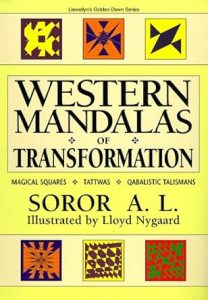
Western Mandalas of Transformation by Soror A.L., with illustrations by Lloyd Nygaard, focuses on magical squares, Qabalistic talismans, and the use of tattwas—providing a hands-on guide for anyone wanting to work directly with these forms. This isn’t a theoretical overview; it’s a practical manual designed to help you craft and charge physical objects that can support spiritual development and focus magickal intent.
The central message is clear: talismans aren’t just tools for wish fulfillment. Instead, they act as keys to unlocking deeper mysteries of nature and divinity while strengthening the will and fostering self-awareness. Soror A.L. grounds the work within the Hermetic Qabalah and Golden Dawn framework, providing the historical background but focusing heavily on practical application. This emphasis on “doing the work” makes the book especially useful for practicing occultists who want to integrate these techniques into their daily magickal routines.
The Power of Talismans and Magical Squares
The book highlights the idea that a talisman’s real power lies in its effect on the magician. By creating and consecrating a talisman, you engage deeply with planetary and elemental forces, reinforcing your intention. This resonates with the concept found in other manifestation practices—like writing checks to yourself or crafting gratitude letters. The physical act of creation focuses the mind over time, anchoring intention in the material world. Incorporating traditional correspondences—colors, metals, scents, and planetary hours—further amplifies this process.
At the core of talismanic creation are the planetary kameas, or magical squares. Each planet corresponds to a unique numeric grid where every row and column sums to the same value. These grids are used to trace sigils—symbols that embody the planetary essence. For example, a Mars talisman would be based on the Mars kamea and could be used to amplify qualities like courage or decisive action. The text also points out that mistakes in the Venus and Mercury kameas are common, even in private Golden Dawn teachings, and provides guidance for correcting these errors.
Correspondences and Timing
A recurring theme is the importance of correspondences. Effective talismans integrate a wide range of symbolic associations—everything from planetary metals and colors to scents and body parts. The book encourages practitioners to work with these layers deliberately. This is not just about aesthetics—it’s about building a multidimensional structure where every element reinforces the talisman’s purpose.
Timing also matters. Crafting a talisman during the correct planetary hour aligns it with the most potent expression of that planetary force. For instance, a Venus talisman for love is most effective when created during Venus’s hour on a Friday, the day traditionally associated with Venus. This timing acts like a current, allowing the magician to ride the planet’s energy rather than working against it.
Ethics and the Holy Guardian Angel
The book doesn’t shy away from ethical concerns. Soror A.L. warns against using talismans for manipulation or harm, emphasizing that any attempt to bend others to your will can backfire. This echoes a broader magickal principle: the will must be developed responsibly and in harmony with natural law.
A significant section is devoted to developing a relationship with the Holy Guardian Angel (HGA)—a central goal in Hermetic Qabalah. The author recommends establishing this connection before engaging in serious talismanic work. This involves learning the divine names, colors, and other attributes associated with your HGA, reinforcing the idea that magickal work is not just about external results but about inner transformation.
Integrating Subjective and Objective Realities
The book takes a nuanced view of whether talismans have independent power. Some schools of thought suggest that a consecrated talisman functions autonomously, while others—like Paracelsus—argue that its true power lies in the effect on the magician’s mind. Soror A.L. adopts a middle ground, treating talismans as both psychological tools and conduits for external forces. This balanced approach allows for practical experimentation without getting lost in metaphysical debates.
There’s also a fascinating exploration of Daath—the hidden sphere on the Tree of Life. Positioned at the threshold between the divine and manifest worlds, Daath represents a point of transition and is attributed to Pluto. It’s rarely addressed in mainstream Qabalistic texts, but here it’s treated as a key to deeper esoteric understanding.
Practical Techniques
The book offers clear, actionable steps for creating and consecrating talismans:
1. **Designing the Talisman:** Identify the appropriate planetary energy, select relevant symbols and correspondences, and choose the correct magical square.
2. **Timing:** Work during the proper astrological conditions and planetary hours to enhance effectiveness.
3. **Consecration:** Use visualization and breathwork to charge the talisman. Imagine the desired color filling both your aura and the talisman itself, infusing it with intent.
The use of tattwas—geometric symbols representing the elements—is another practical technique covered in detail. These are used to channel elemental forces into the talisman, adding another layer of meaning and energy.
Using This Work in Modern Practice
One intriguing takeaway is how these techniques can integrate with modern manifestation practices. Crafting a talisman isn’t that different from creating other physical props used in manifestation—such as vision boards or writing affirmations. Both involve focused intent sustained over time. The added complexity of correspondences in talisman-making deepens this process, giving the practitioner more tools to shape and direct energy.
For example, combining the creation of a talisman with planetary timing mirrors practices like writing abundance checks during a new moon. The work itself becomes a meditation, reinforcing intention while the physical object serves as a touchstone for continued focus.
Final Thoughts
Western Mandalas of Transformation is more than just a guide to making pretty objects. It’s a practical workbook for anyone serious about integrating Qabalistic principles into their magickal practice. By emphasizing hands-on techniques while acknowledging the ethical and spiritual dimensions, Soror A.L. provides a roadmap for personal transformation rooted in Western esoteric tradition.
Whether you’re new to talismanic magick or refining an existing practice, the book offers a grounded, thorough approach. The emphasis on planetary squares, correspondences, and the Holy Guardian Angel makes it especially valuable for those working within the Hermetic framework. At its core, it reinforces a fundamental truth of magick—real change requires both external work and internal transformation, and the act of creation itself can be a vehicle for spiritual growth.